A Brief History of AWS Architectures
Posted on December 20, 2024 • 10 min read • 2,054 wordsInitially designed for Amazon's e-commerce platform, it took several years before AWS fully embraced cloud computing.
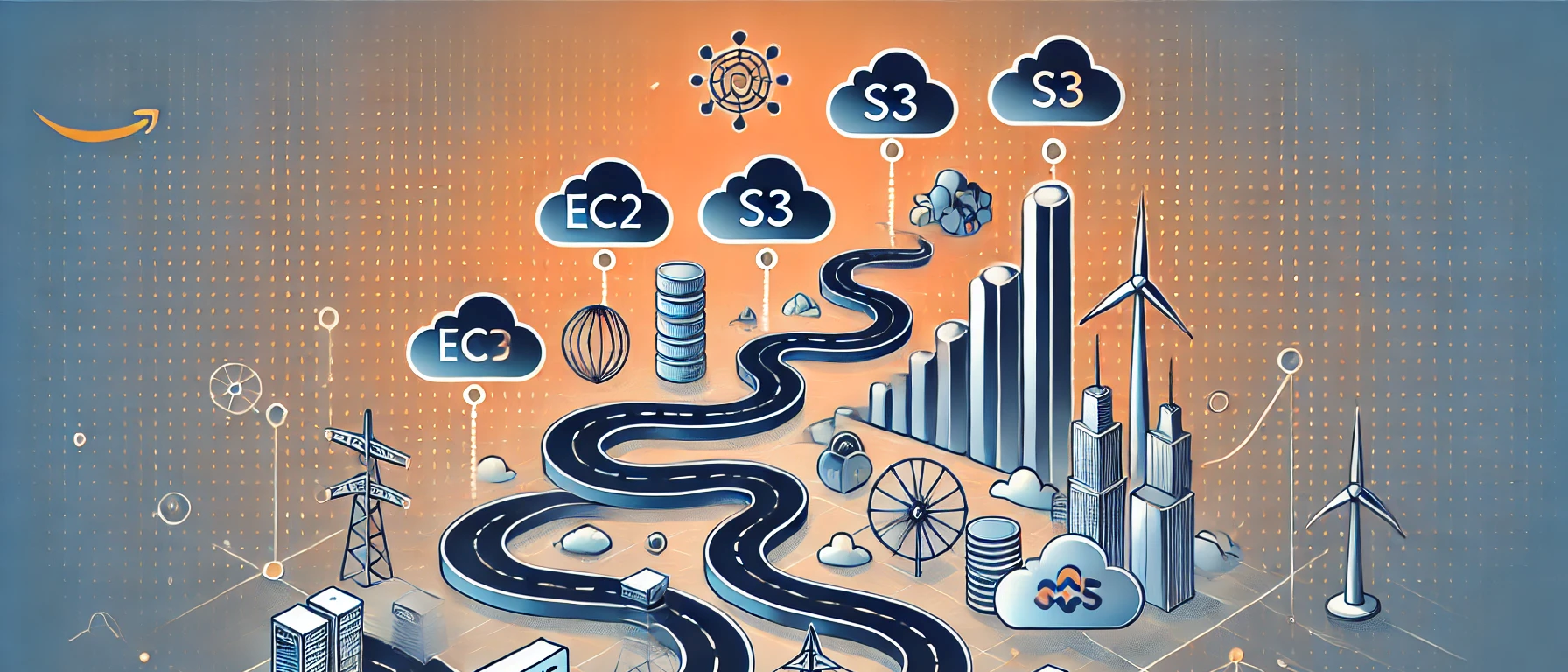
I. The Early Days of AWS and Cloud Computing (2002 - 2006)
Context: The Origin of the AWS Project
Before AWS became a cloud giant, Amazon.com (the e-commerce site) had to manage a massive IT infrastructure to support its rapid growth. The company invested in expensive data centers and had to anticipate server capacity for peak traffic periods (such as Black Friday). However, much of this capacity remained unused outside of high-demand periods.
Amazon’s internal teams identified a problem: developers were spending too much time managing IT resources instead of focusing on creating new features. To address this, Amazon started designing a platform that would provide infrastructure services via APIs, allowing teams to access resources on demand.
This idea evolved into a service open to external businesses, enabling organizations to access computing resources flexibly without investing in physical hardware.
2002: The First Amazon Web Services
Amazon discreetly launched AWS in 2002, but it was not yet the cloud computing service we know today. At that time, AWS primarily offered web APIs to access Amazon product data, such as:
- AWS SOAP & REST API: Providing programmatic access to certain Amazon site features.
- Alexa Web Information Service: Offering web statistics and search trend data.
These early services were not yet related to hosting or infrastructure but laid the foundation for AWS’s future model: providing IT services through remotely accessible APIs.
2003 - 2004: The Cloud Computing Concept Takes Shape
During this period, Amazon continued improving its internal infrastructure. Engineers realized their platform could be designed to host and manage any application, not just Amazon’s.
Three key concepts emerged:
- Standardizing IT resources: Servers, storage, and databases should be accessible as modular services.
- Automating resource allocation: Allowing developers to obtain servers on demand instead of waiting for manual installations.
- Usage-based billing: Inspired by utilities (like electricity), AWS would charge businesses based on actual consumption rather than fixed subscriptions.
Amazon decided to fully commit to this idea and began designing a cloud service offering for businesses.
2006: AWS Officially Launches with Its First Cloud Services
The year 2006 marked AWS’s official debut as a cloud computing provider. Three foundational services were introduced:
Amazon S3 (Simple Storage Service)
- A scalable object storage service accessible via API.
- Allows businesses to store and retrieve files easily without managing servers.
- Innovative pricing model based on storage used ($0.15/GB at the time).
Amazon EC2 (Elastic Compute Cloud)
- A service allowing users to launch virtual machines (VMs) on demand.
- Provides a flexible alternative to traditional physical servers.
- Enables developers to rent Linux servers by the hour and stop them when no longer needed.
Amazon SQS (Simple Queue Service)
- A messaging service that enables asynchronous communication between applications.
- Helps prevent overload issues by distributing tasks across multiple servers.
These services became the pillars of modern cloud computing. For the first time, businesses could launch servers and store data without needing their own physical infrastructure.
Impact and Adoption
AWS revolutionized enterprise IT by enabling startups and developers to access computing resources elastically.
Companies like Netflix, Dropbox, and Airbnb quickly adopted AWS because it allowed them to scale without purchasing physical servers. The pay-as-you-go model was a major shift from traditional fixed-subscription or costly hardware purchase models.
Conclusion of the 2002 - 2006 Period
✅ AWS evolved from a simple set of APIs for Amazon into a true cloud platform offering storage (S3), computing power (EC2), and messaging management (SQS).
✅ This model laid the foundation for modern cloud computing and sparked a revolution in how businesses design their IT infrastructure.
II. The Rise of Cloud Computing (2007 - 2012)
Context: AWS Becomes a Major Cloud Player
After its official launch in 2006, AWS began gaining recognition in the IT infrastructure world. Companies and startups increasingly adopted the cloud to reduce costs and gain flexibility. AWS distinguished itself from traditional providers by offering a pay-as-you-go model, revolutionizing the IT market approach.
This period was marked by:
- The rapid expansion of AWS services
- Massive adoption by startups and tech companies
- The emergence of databases and private cloud solutions
2007 - 2008: Early Use Cases and Storage Expansion
Netflix began using AWS to host its streaming videos, marking one of the first large-scale cloud use cases. AWS launched Elastic Block Store (EBS) in 2008, allowing EC2 instances to have persistent storage.
2009 - 2010: Managed Databases and Virtual Private Cloud (VPC)
Amazon responded to demand with several new services:
- Amazon RDS (2009): Managed relational database service.
- Amazon VPC (2009): Introduced the concept of private cloud.
- AWS CloudFront (2009): Content Delivery Network (CDN).
2011 - 2012: The Explosion of Services and the Big Data Era
Amazon launched several strategic services:
- Amazon DynamoDB (2012): Highly scalable NoSQL database.
- AWS Elastic Beanstalk (2011): PaaS for application deployment.
- Amazon Redshift (2012): Cloud data warehouse for Big Data.
Conclusion of the 2007 - 2012 Period
✅ AWS became a dominant player thanks to its diverse services. ✅ Databases, VPCs, and Big Data accelerated enterprise adoption. ✅ Startups migrated en masse to AWS, creating success stories like Netflix and Airbnb.
III. The Shift to Modern Architectures (2013 - 2017)
Context: AWS Dominates the Cloud Market
Between 2013 and 2017, AWS solidified its position as the market leader in cloud computing. It outpaced competitors (Google Cloud, Microsoft Azure) through continuous innovation and widespread adoption by businesses and startups.
Key trends during this period:
- The rise of microservices architectures with containers and Kubernetes.
- Development of Serverless services to simplify application deployment.
- AI and Machine Learning became accessible via AWS.
2013 - 2014: Security and Service Expansion
Amazon continued expanding its offerings and improving security to attract large enterprises and government agencies.
Major services during this period:
- AWS IAM (2013): Advanced access and permission management.
- AWS KMS (2014): Encryption key management service.
- Amazon Aurora (2014): High-performance cloud database compatible with MySQL and PostgreSQL.
2015 - 2016: The Rise of Microservices and Serverless
Key services:
- Amazon ECS (2015): Docker container management.
- AWS Lambda (2014, adopted in 2015): Serverless computing.
- Amazon API Gateway (2015): Serverless API management.
2016 - 2017: AI and Machine Learning Integration
Major AI/ML services:
- Amazon Rekognition (2016), Polly (2016), Lex (2016), SageMaker (2017)
✅ Serverless and microservices architectures revolutionized the cloud. ✅ AWS invested heavily in AI and Machine Learning.
IV. Hybrid Cloud, Multi-Cloud, and Edge Computing (2018-2022)
Context: AWS Facing Increased Competition
During this period, AWS continued to dominate the cloud market, but competition intensified with Microsoft Azure and Google Cloud gaining ground, especially among large enterprises.
Three major trends emerged:
- Hybrid cloud and multi-cloud – Companies wanted to combine AWS with their data centers and other cloud providers.
- Edge Computing – AWS deployed services closer to users to improve latency.
- Cost optimization and sustainability – AWS introduced new services to reduce energy consumption and infrastructure costs.
2018 - 2019: The Cloud Becomes Hybrid, and Workloads Extend Beyond AWS
Large enterprises were still hesitant to move everything to the public cloud. AWS responded with hybrid solutions to integrate the cloud with their data centers.
Key services:
-
AWS Outposts (2018) – AWS in private data centers
Allows companies to install AWS hardware on-premises.
Compatible with EC2, S3, and other AWS services. -
AWS Transit Gateway (2018) – Multi-cloud and hybrid networking
Centrally connects VPCs, data centers, and other clouds.
Facilitates AWS integration with Azure or Google Cloud. -
AWS Security Hub (2018) – Centralized security
Unifies security alerts across all AWS resources.
Impact:
AWS adapted to the needs of large enterprises by offering more flexible solutions integrated with existing data centers.
2020 - 2021: The Rise of Edge Computing and Distributed Architectures
With the growth of IoT and applications requiring low latency, AWS introduced services that allow workloads to run closer to users.
New Edge Computing services:
-
AWS Wavelength (2020) – AWS in 5G networks
Integrated into 5G networks to reduce latency to milliseconds.
Enables AR, IoT, and other low-latency applications. -
AWS Local Zones (2020) – Mini AWS data centers in cities
Deployed in major cities (Los Angeles, New York, Paris…) to offer ultra-fast performance. -
AWS Proton (2020) – DevOps automation
Simplifies the deployment of microservices and containers on AWS.
Impact:
AWS became a key player in Edge Computing, improving latency for gaming, streaming, and IoT applications.
2022: AWS Focuses on Sustainability and Cost Optimization
Amid growing concerns over the environmental impact of cloud computing, AWS launched initiatives to improve energy efficiency.
Major actions:
-
AWS Graviton (2021-2022) – ARM processors for lower energy consumption
Up to 40% more efficient than Intel/AMD processors.
Used in EC2, Lambda, RDS, reducing costs and carbon footprint. -
Amazon Sustainability Data Initiative (2022) – Environmental data
Provides free datasets to help companies reduce their carbon footprint. -
AWS Compute Optimizer (2022) – Cloud cost reduction
Analyzes resource usage and recommends optimizations to lower AWS expenses.
Impact:
AWS emphasized performance optimization and cost reduction while committing to a greener cloud.
Conclusion of the 2018-2022 Period
✅ AWS embraced hybrid and multi-cloud strategies to attract large enterprises.
✅ Edge Computing became a key focus, with AWS Wavelength and Local Zones.
✅ AWS improved sustainability and offered solutions to reduce costs.
V. Hybrid Cloud, AI, and Sustainability (Present Period)
Context: AWS Facing New Cloud Challenges
Since 2023, AWS has continued to innovate to address three major trends:
- Generative AI and Machine Learning – With the rise of ChatGPT and LLMs, AWS accelerated its AI efforts.
- Sovereign cloud and data regulation – Governments and enterprises demand more control over their data.
- Cost and performance optimization – Amid economic uncertainty, AWS offers more cost-effective and sustainable solutions.
2023: AWS Joins the AI Race
The launch of ChatGPT in 2022 accelerated the competition in generative AI. AWS responded with Amazon Bedrock and new AI services to compete with Azure OpenAI and Google Vertex AI.
Key services:
-
Amazon Bedrock (2023) – Generative AI on AWS
Provides access to pre-trained AI models (Anthropic Claude, Stability AI, AI21, Amazon Titan).
Simplifies AI integration into applications without advanced technical expertise. -
AWS Trainium & Inferentia2 (2023) – AI/ML optimized chips
AWS-developed AI processors to speed up training and inference.
An alternative to NVIDIA GPUs, reducing costs and dependency on external suppliers. -
Amazon Q (2023) – Conversational AI for enterprises
AI-powered chatbot specialized in document management and customer support.
Integrated with AWS tools to enhance developer and analyst productivity.
Impact:
AWS became a key player in generative AI, enabling companies to build chatbots and AI assistants without relying on OpenAI.
2024: Strengthening Sovereign Cloud and Data Security
With increasing regulations (GDPR, European Data Act), AWS developed sovereign cloud and data protection solutions.
Key initiatives:
-
AWS European Sovereign Cloud (2024) – A cloud dedicated to European data
Designed to comply with strict European regulations (GDPR, Data Act).
Fully hosted in Europe, with enhanced data access controls. -
AWS Nitro Enclaves – Advanced data security
Enables isolated environments for processing sensitive data.
Protects against unauthorized access, even by AWS administrators.
Impact:
AWS reassured governments and European enterprises by ensuring compliance with data regulations.
2024 - Present: Cost Optimization and Edge Computing Innovations
With growing economic concerns, AWS optimized its offerings to help enterprises cut cloud costs.
New services and strategies:
-
AWS Graviton4 (2024) – Even greater energy efficiency
Next-generation ARM processors to reduce server energy consumption.
Up to 40% more performance compared to Graviton3. -
AWS Outposts & Local Zones – Global expansion
AWS expanded its infrastructure to reduce latency and enhance Edge Computing performance.
Partnerships with telecom operators for 5G and IoT applications.
Impact:
AWS remained competitive by offering more cost-effective and high-performance solutions tailored to post-COVID enterprise needs.
Conclusion of the 2023 - Present Period
✅ AWS accelerated its generative AI efforts with Bedrock and its own AI chips.
✅ Sovereign cloud became a priority with AWS European Sovereign Cloud.
✅ Cost optimization and Edge Computing continued to evolve.
General Conclusion: The Evolution of AWS Architectures (2002 - 2025)
AWS evolved from simple virtual machines (EC2) and storage (S3) in 2006 to a highly diverse cloud platform with:
- Serverless services and Kubernetes (2014 - 2017).
- Edge Computing and hybrid solutions (2018 - 2022).
- Generative AI and sovereign cloud (2023 - today).
The future of AWS will be shaped by AI, data sovereignty, and energy cost reduction.