Demystifying AWS KMS
Posted on January 19, 2025 • 9 min read • 1,829 wordsA Comprehensive Guide to Cloud Security for Your Business

I. Introduction to AWS KMS
A. What is AWS KMS?
AWS KMS, short for Key Management Service, is a fully managed service designed to simplify the creation, management, and control of encryption keys. Everytime encryption is mentioned in AWS services like EBS, S3, RDS, or SSM, AWS KMS is probably involved. This service integrates seamlessly with IAM and, of course, it also ensures robust access control and auditing through CloudTrail.
The primary purpose of AWS KMS is to secure your sensitive data by managing encryption keys effectively. For example, instead of storing secrets like API keys in plain text within your code (which you should never do), you can use KMS API calls to encrypt and safely store them. This eliminates risks associated with storing plain text and provides peace of mind that your data is protected against unauthorized access.
Encryption plays a critical role in safeguarding data within cloud environments by converting it into unreadable formats. This ensures privacy, regulatory compliance, and protection during storage and transmission, minimizing the risks of data breaches in shared cloud infrastructures.
B. The Role of Encryption in Data Security
Encryption is absolutely crucial to enhancing security across the internet. It ensures that only authorized individuals can access sensitive information, such as passwords or confidential data.
Here are three widely used encryption methods:
- Encryption in Transit (TLS/SSL): This method secures data in motion, preventing attacks like man-in-the-middle (MITM) attacks. Only the intended recipient can decrypt and access the information using certificates.
- Server-Side Encryption at Rest: Data is encrypted when stored on the server and decrypted before transmission thanks to encyption keys.
- Client-Side Encryption: Data is encrypted on the client-side and remains encrypted throughout its journey. Only the receiving client can decrypt it, keeping it secure from the server.
C. Business Needs for Secure Key Management
Inadequate key management practices, such as insecure storage or improper sharing of keys, can lead to unauthorized access, data breaches, and operational failures. Moreover, key handling opens the door to security vulnerabilities that can compromise business operations and erode customer trust or even cause legal problems in the long run.
Regulations like GDPR, HIPAA, and PCI-DSS require businesses to implement strong data protection measures, including secure key management. Thus, ensuring compliance is not only about avoiding penalties but also about demonstrating a commitment to safeguarding sensitive information!
Whether you’re a tech nerd developping your small service or a multinational company, security must be a priority. AWS KMS simplifies encryption key management, offering automation, scalability, and integration with AWS services. Any business can protect sensitive data, ensure regulatory compliance, and focus on growth, all while maintaining a strong security posture.
II. Understanding AWS KMS Functionality
A. Core Features of AWS KMS
Description of KMS Keys
In general, you have two types of encryption keys:
- Symmetric Keys: A single key used for both encryption and decryption.
- Asymmetric Keys: A public key encrypts data, while a private key decrypts it. The public key is downloadable, but the private key is securely stored and not accessible in plaintext.
And AWS KMS provides four types of keys:
- AWS-Owned Keys: Fully managed by AWS for services like SSE-S3, SSE-SQS, and SSE-DDB.
- AWS-Managed Keys: Created automatically for specific services, such as AWS/RDS.
- Customer-Managed Keys: Created and managed by customers with full control over permissions and usage.
- Customer-Imported Keys: Keys imported by customers to meet specific requirements, offering complete control over their lifecycle.
KMS Key Policies
Key policies in AWS KMS determine access to encryption keys. Without an appropriate policy, no access to the KMS key is granted.
There are two types of policies:
- Default Policies: Created automatically if no custom policy is provided. These allow broad access to the key, which means every user can access the key.
- Custom Policies: Allow precise control over user or role access, including cross-account permissions. Custom policies are essential for tailored security and multi-account architectures.
Multi-Region Key Management Capabilities
KMS keys can are region-specific, meaning encryption and decryption must occur within the same region. For example, if you encrypt an EBS volume with KMS key A in one region, creating a snapshot and migrating it to another region requires re-encryption with KMS key B. This ensures security while maintaining regional compliance. However, it is also possible to have Multi-Region Capabilities. This means you can have a copy of the same key with the same ID in multiple regions. We can dive deeper into this functionality in another blog post.
B. Integration with Other AWS Services
AWS KMS integrates seamlessly with numerous AWS services, including S3, RDS, Lambda, and EBS, enabling robust encryption workflows. For instance:
- S3 can encrypt objects automatically using AWS-managed or customer-managed KMS keys.
- RDS leverages KMS for encrypting databases and snapshots.
These integrations simplify encryption management and enhance security across the AWS ecosystem, making AWS KMS indispensable for modern cloud architectures.
C. Monitoring and Auditing with KMS
AWS KMS provides extensive logging and monitoring capabilities through services like CloudTrail and Amazon CloudWatch. Key usage events are recorded, creating an auditable trail to meet compliance requirements and detect unauthorized activity. Alerts can also be configured to proactively identify and respond to potential security incidents, ensuring a robust security posture.
III. Setting Up AWS KMS for Your Business
A. Getting Started with AWS KMS
- Step-by-step guide to creating your first key
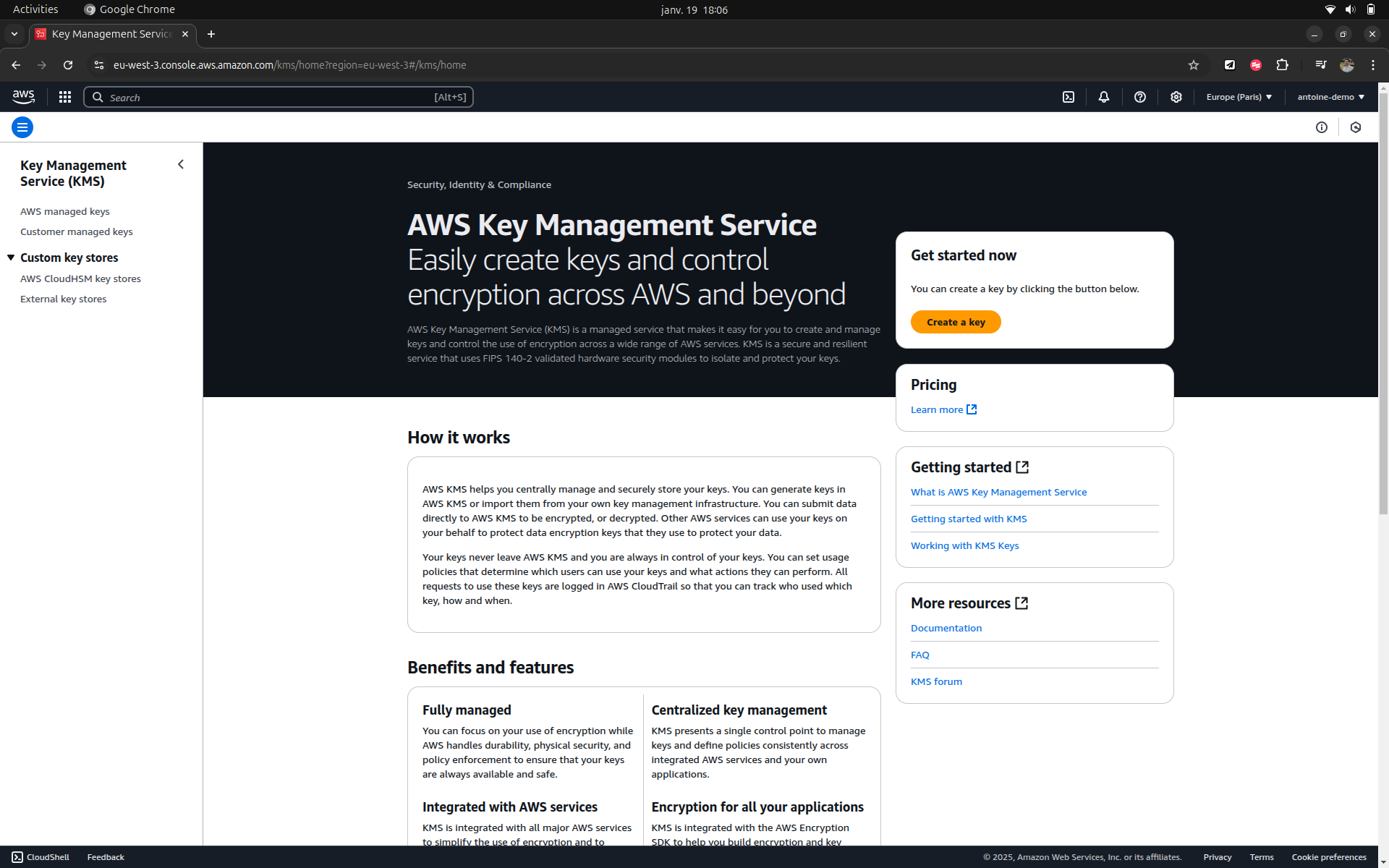
- Go to KMS
- Click on Customer Managed Key
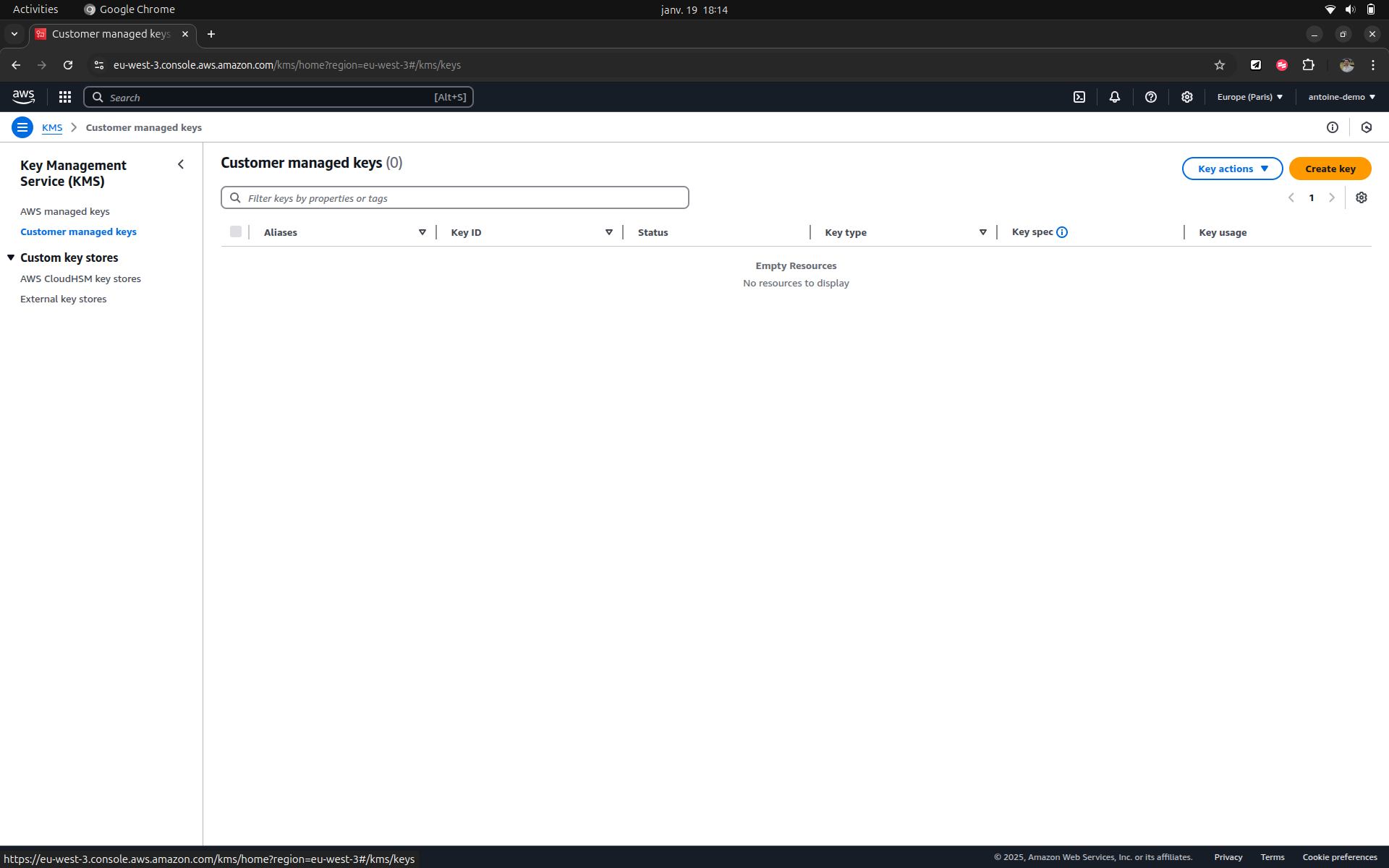
Then Create a key
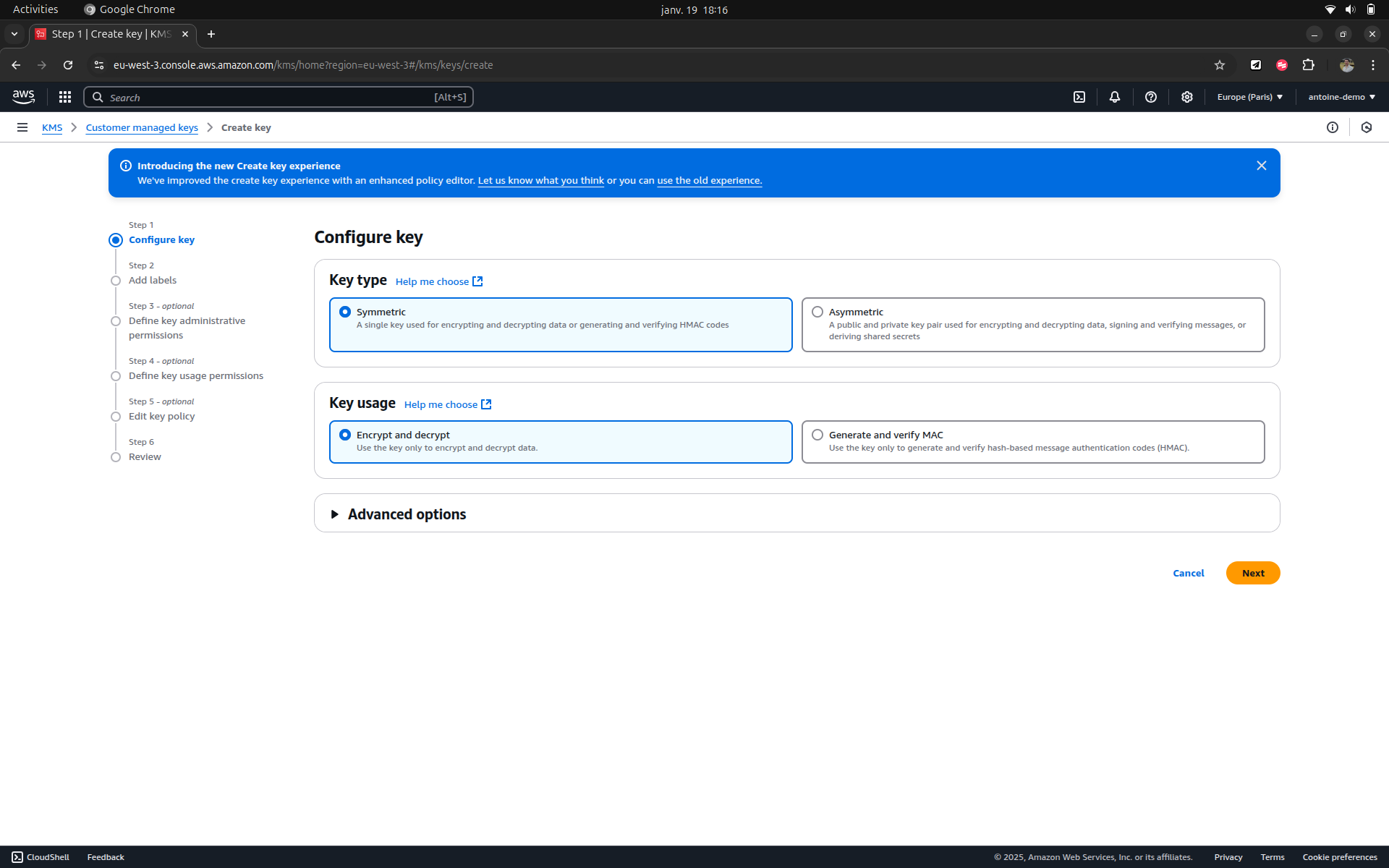
- Use the symmetric key type as well as the encrypt and decrypt key usage.
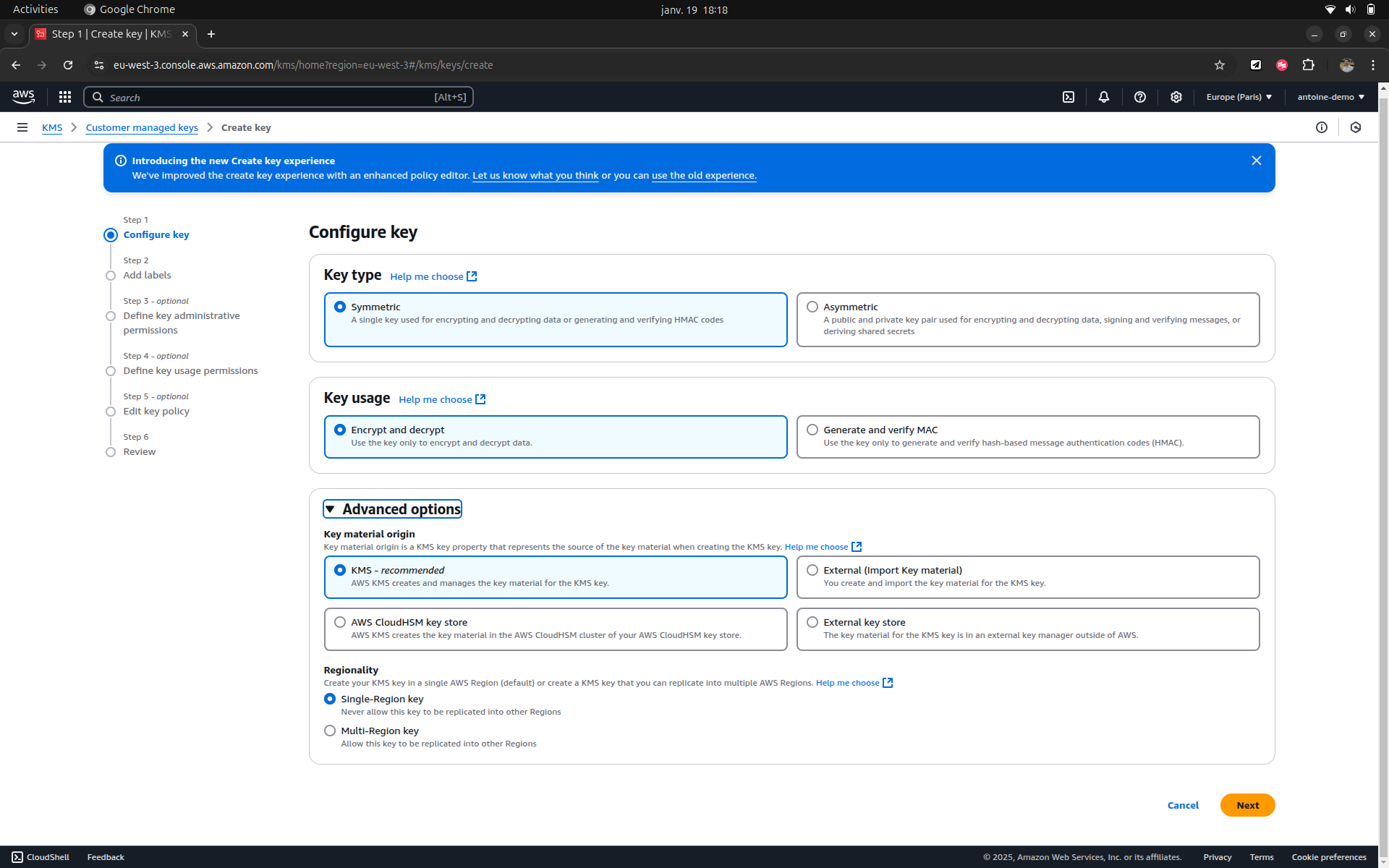
- Finally, choose KMS for the key meterial origin and the single-region key for the regionality as this is the most common type of key we use.
- Choose an alias if you want.
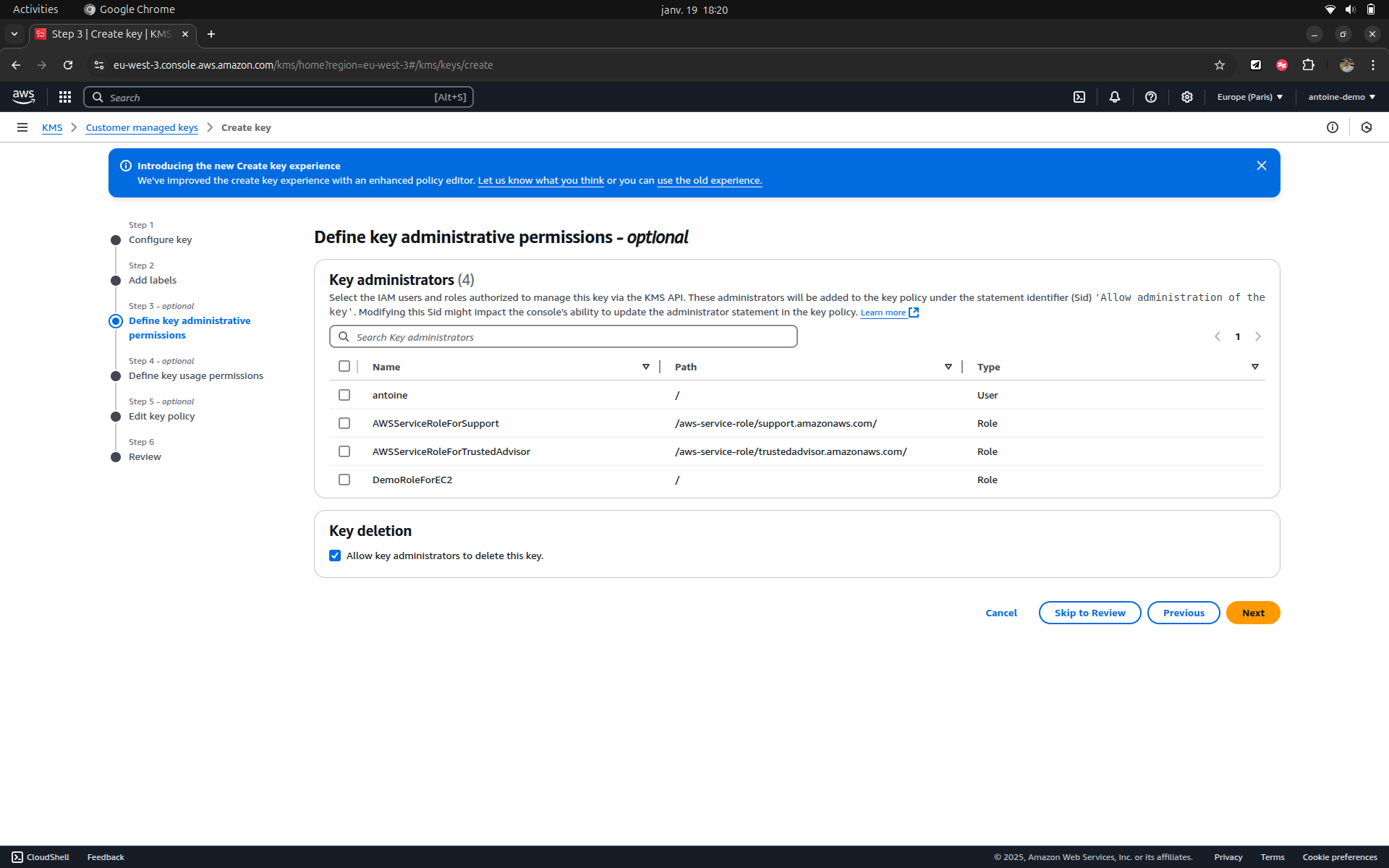
- Here we can define key administrators. Here by default, we’re going to use the default KMS policy as we defined earlier. However you can also define other custom policies to have extra security.
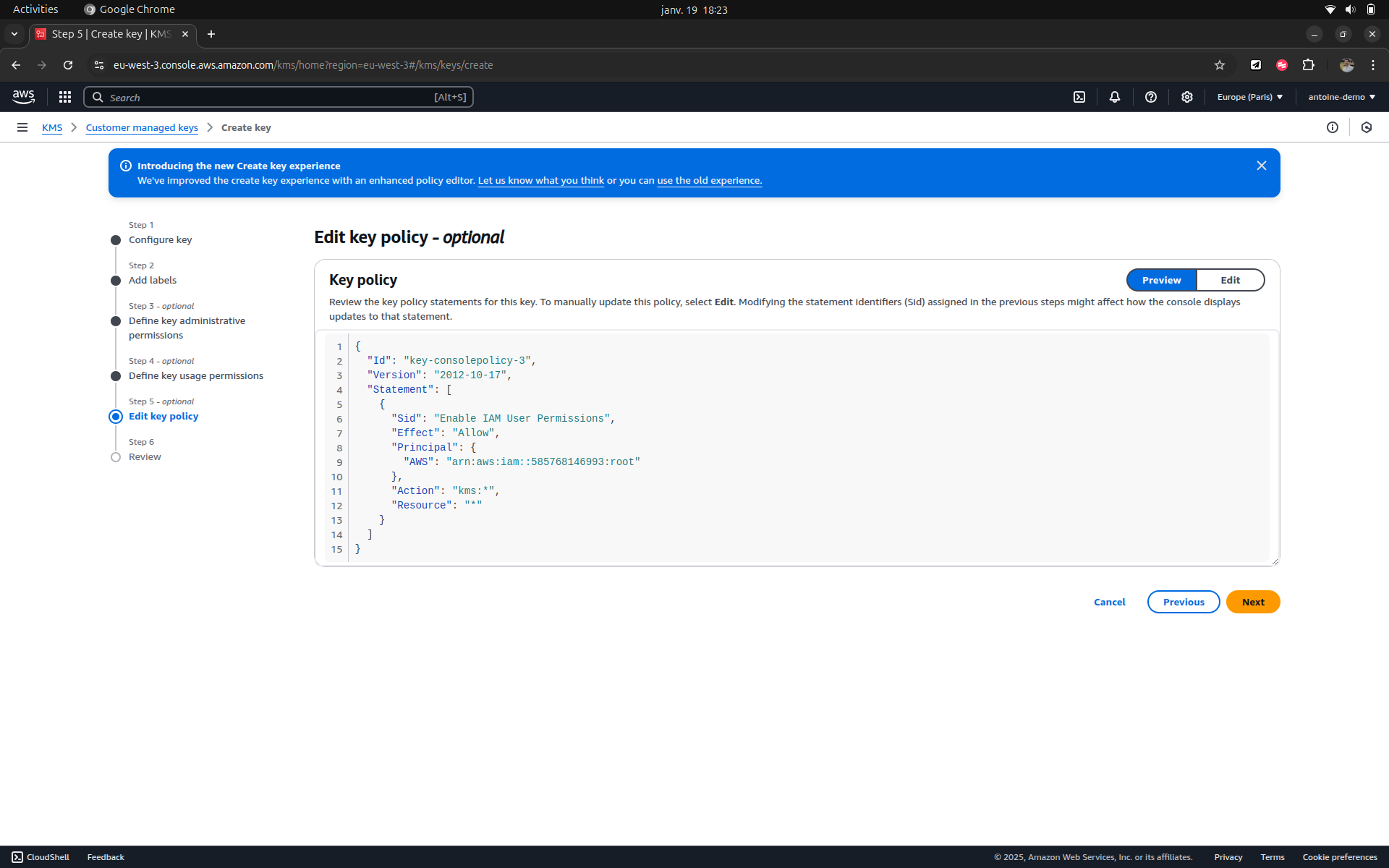
- Here you have the summary of the key policy:
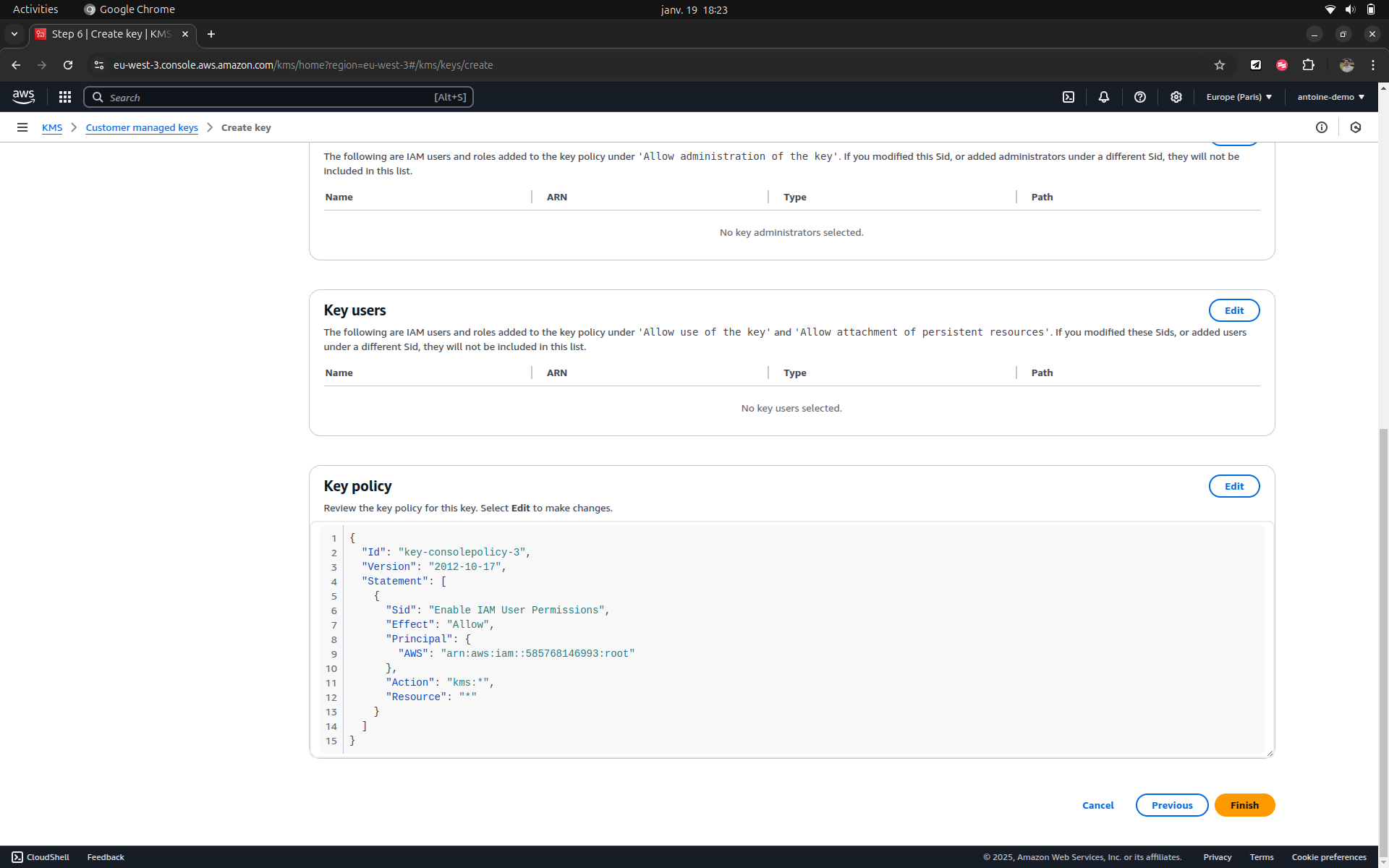
- And finally click on finish to create the key:
B. Advanced Key Management Techniques
- Best practices for key rotation and expiration
- Strategies for managing multiple accounts and keys
- KMS multi region keys ??
IV. Use Cases of AWS KMS in Different Industries
A. Financial Services and Banking
Financial institutions handle quite sensitive information, such as customer account details, credit card numbers, and transaction records. Taken this into account, encrypting this data makes sure its confidentiality and integrity during storage and transmission while reducing the risk of fraud and cyberattacks.
Compliance with stringent regulations like PCI-DSS (Payment Card Industry Data Security Standard) is mandatory for organizations handling cardholder data. AWS KMS helps meet these requirements by enabling secure encryption, automated key rotation, and fine-grained access control. For instance, financial institutions can use customer-managed keys to encrypt transaction logs. This ensures data protection and regulatory compliance.
One prominent use case involves a global payment processor leveraging AWS KMS to secure millions of daily transactions. By integrating KMS with AWS services like S3 and RDS, the organization achieved seamless encryption of customer data while ensuring compliance with GDPR and PCI-DSS. The move to AWS KMS significantly reduced manual key management efforts, enabling the company to focus on innovating financial products.
B. Healthcare and Life Sciences
Healthcare organizations manage sensitive patient information, including electronic health records (EHRs) and clinical research data. Encryption ensures this data remains confidential and tamper-proof, addressing risks like unauthorized access and data breaches.
AWS KMS simplifies compliance with regulations like HIPAA (Health Insurance Portability and Accountability Act) by securely encrypting Protected Health Information (PHI). Features such as audit logging and granular access control allow healthcare providers to track who accesses encryption keys and ensure only authorized personnel can decrypt sensitive data.
A leading healthcare provider used AWS KMS to encrypt its patient management system hosted on AWS. By combining KMS with CloudTrail, the organization ensured complete visibility into key usage, meeting HIPAA audit requirements effortlessly. Additionally, AWS KMS enabled secure data sharing between research teams, accelerating breakthroughs in drug development without compromising security.
C. Retail and E-Commerce
Retailers and e-commerce platforms handle vast amounts of personal and financial data, including payment information, addresses, and purchase histories. AWS KMS ensures this data is encrypted both at rest and in transit, mitigating the risk of data breaches and fraud.
Retailers often rely on big data analytics to derive insights from customer behavior. AWS KMS enables the secure encryption of analytics data stored in data lakes or warehouses like Amazon Redshift. This ensures data remains secure while allowing businesses to analyze trends and improve customer experiences.
A global e-commerce platform implemented AWS KMS to encrypt its customer transaction database. The platform leveraged customer-managed keys for additional control over access permissions. This not only enhanced security but also built customer trust by demonstrating a commitment to protecting sensitive information. Furthermore, by using KMS in conjunction with AWS Lambda, the platform automated key rotation, ensuring long-term security without operational overhead.
V. Summary and Conclusion
AWS KMS offers everything you need for your business: a robust, scalable, and secure solution for managing encryption keys, making it an essential tool for businesses that rely on cloud services. By seamlessly integrating with a wide range of AWS offerings, KMS simplifies the encryption process, automates key management, and provides detailed auditing capabilities. Key features like customizable key policies, multi-region capabilities, and support for both symmetric and asymmetric encryption ensure that organizations of all sizes can tailor KMS to meet their unique security needs.
In today’s digital landscape, secure key management is no longer optional but a necessity. Poor encryption practices and weak key management expose organizations to significant risks, including data breaches, regulatory non-compliance, reputational damage and so much more. AWS KMS addresses these challenges by providing centralized, secure, and compliant management of encryption keys, enabling organizations to protect sensitive data across diverse environments.
Adopting AWS KMS is a strategic move for businesses aiming to enhance their security posture and streamline compliance efforts. Its integration with other AWS services, coupled with its user-friendly interface and advanced features, ensures businesses can focus on growth while maintaining high standards of security. Whether you are a startup securing customer data or an enterprise meeting complex regulatory requirements, AWS KMS provides the foundation for building a secure, scalable, and resilient cloud infrastructure.
VI. Frequently Asked Questions (FAQs)
A. What are the costs associated with AWS KMS?
Pricing | AWS Key Management Service (KMS) | Amazon Web Services (AWS)
B. How do I migrate existing keys to AWS KMS?
If you follow the tutorial part III, you can import your key in the advanced options by selectioning External for key material origin.
C. Can AWS KMS be used for on-premises applications?
Yes KMS can be used through API calls which means it can be used for on-premises applications.
D. How many request can I do per month with the free tier?
You can start with 20.000 requests per month with the AWS free tier.